Guided demo · one loan decision
One decision, proven, traced to its cause and fixed.
This is the case the story on bitexact.ai tells: loan application APP-7731, declined by an underwriting agent. Every view below is the BitExact inspector's own screen, captured from the recorded run. The model is a local stand-in with seeded answers, so the case records the same way every time.
SEALED loan-APP-7731 · 9 entries · sealed and signedOne recorded run
An underwriting agent decides an application. Then someone asks why.
Four steps, each with the view the inspector showed for this run.
-
01
The agent declines the application.
The agent pulls the application, a credit report and the policy, asks the model, and answers decline:
The credit score of 512 is below the 620 minimum.
BitExact records each of those calls as it happens, and the agent's decision record beside them: an automated adverse action, reason code SCORE_BELOW_MIN, with a retention date committed to the chain.
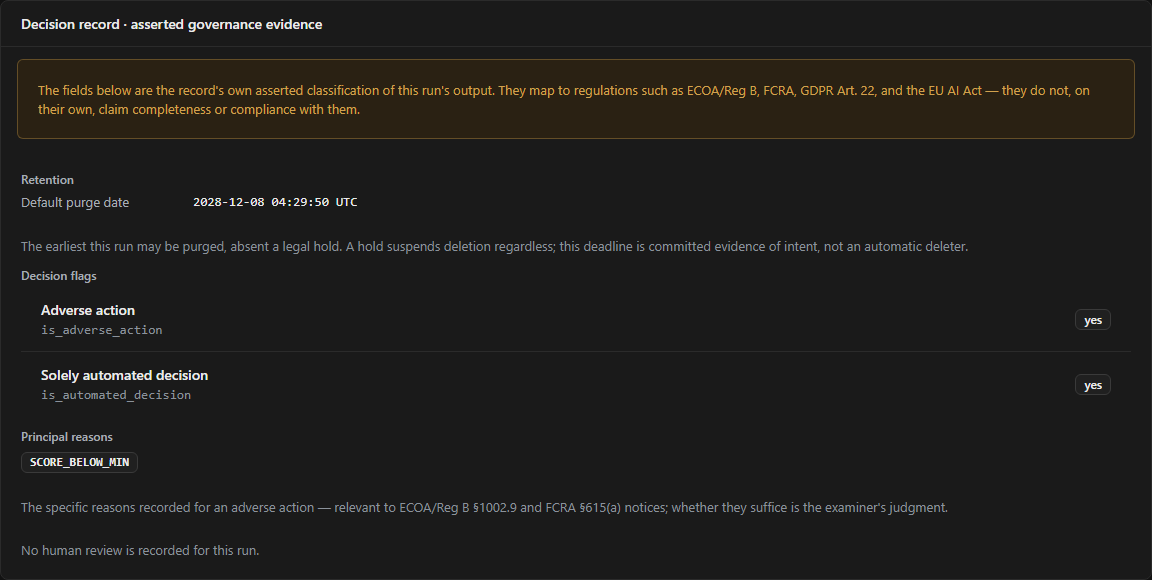
loan-APP-7731 · the decision record -
02
The record is intact, sealed and signed.
Unchanged · sealed · signedNothing recorded has been changed or removed, the run is sealed so steps lost from its end would show, and it is signed by the deployment's recorder key. What the record does not claim is stated on it: that this is every call the agent made.
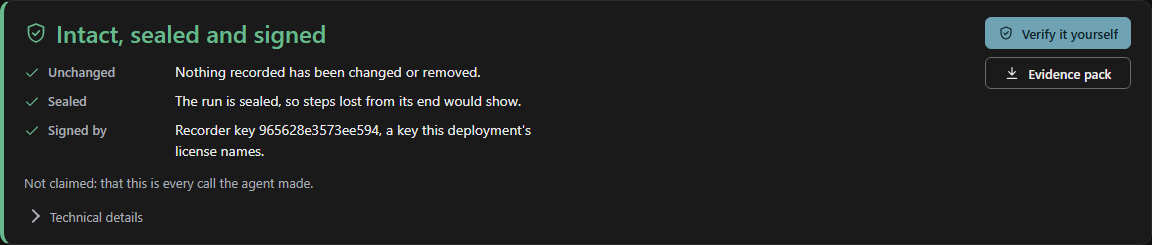
loan-APP-7731 · the run's integrity -
03
The score belonged to someone else.
Step 4 · pull_credit_reportAsked for APP-7731, the credit-report tool returned the report of APP-7713, score 512. The bureau mirror holds no file for this applicant yet, so the tool returned the file with the nearest number. The model applied the policy exactly, to the wrong person's score.
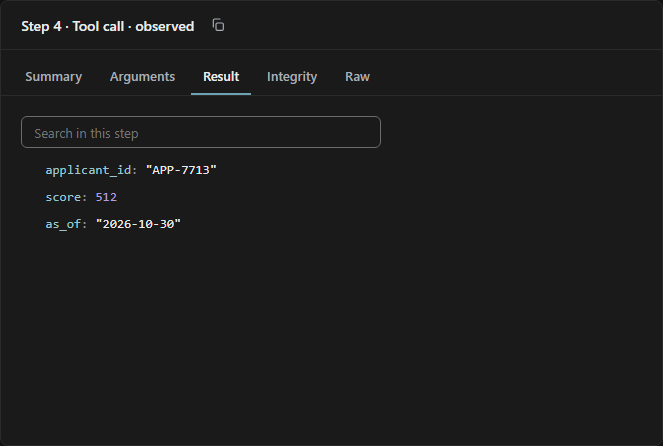
loan-APP-7731 · step 4 · the tool's result -
04
Fork at that step with the fix, and compare.
With pull_credit_report matches the applicant exactly, the recorded run is forked at step 4 and re-run live from there. The fork answers refer:
The bureau mirror holds no report for APP-7731, so there is no score to apply the policy to; request a fresh bureau pull.
The fork is marked synthetic and linked to its source, so it can never pass for what production did.Was the decline a fluke? Forked 20 times at the same step:
- as it was: 19 decline, 1 refer
- with the fix: 20 refer
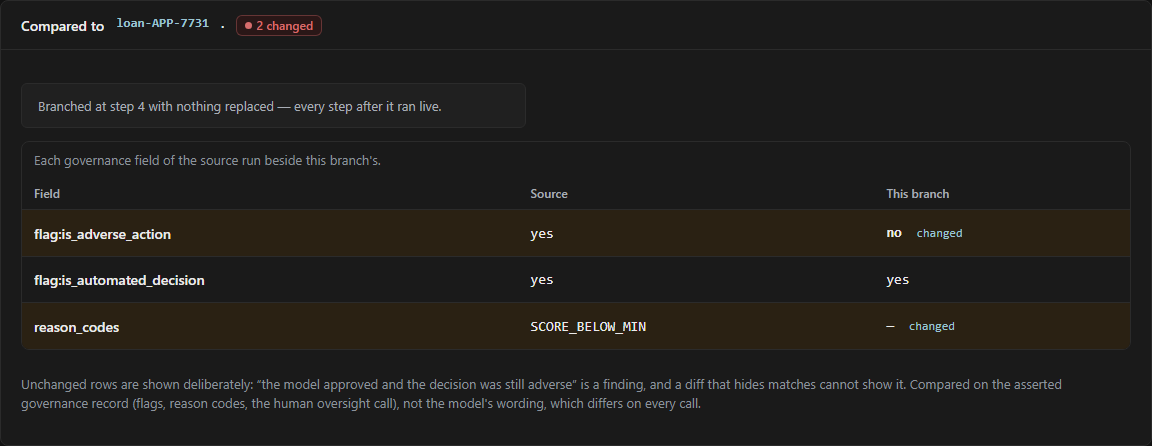
loan-APP-7731-candidate · compared to its source
Verify it yourself
You do not have to take our word for it.
The verifier is a standalone Apache-2.0 tool: the Python standard library plus cryptography and asn1crypto, none of our product code. Whoever is asking runs it on the exported bundle and re-derives every hash and signature themselves, with no BitExact license and no network.
$ python bitexact_verifier.py golden-run.bundle.json --trust-file trust.json --expect-witness witness.example=bcd33f91b6ed…
OK: golden-run - 4 steps (observed 4 / asserted 0 / synthetic 0), chain verified, sealed, signed, recorder-attested, in transparency log bitexact.log/eb0180bca503ff76 (leaf 3 of 66), witnessed by 1 of 1 pinned (1 with ML-DSA-44, post-quantum), signatures: Ed25519 + ML-DSA-65 (post-quantum), post-quantum key pinned
standing when recorded: ok (stated by the producer, not proof)
captured via sdk-python 3, unlabeled 1 (attribution, not proof)
$ echo $?
0

$ python bitexact_verifier.py golden-run.tampered.bundle.json --trust-file trust.json --expect-witness witness.example=bcd33f91b6ed…
FAIL: step 1: data hash mismatch at path result.temp - value tampered or corrupted
$ echo $?
2
How it fits
Evidence beside the stack you already run.
Your observability tools stay where they are. BitExact wraps the interfaces your agents already use. This is how the agent in this case was recorded:
def main():
    client = OpenAI()
    with bitexact.run("loan-APP-7731", workflow="loan-adjudication",
                      workflow_instance="APP-7731", environment="demo",
                      principal="svc:underwriter") as r:
        client = wrap_openai(client, r)
        result = decide(client, "APP-7731")
        record_outcome(r, result)
Plugs into your stack
LangChain, LangGraph, LangSmith, OpenTelemetry, or raw Python. Wrap the client and the tools; the agent code doesn't change.
Stays in your network
Self-hosted, no phone-home. The license is an offline-validated signed file, with no code path that could call out.
Speaks compliance
Automatic, tamper-evident capture for EU AI Act Art. 12; decision records carry reason codes and a retention deadline. The mapping to each regime, with its limits, is on the compliance page.
Next step
Run it on your own traffic.
A design-partner pilot is a full production deployment recording real traffic, with direct engineering support, under a fixed-term license. Continue and the pilot fee is credited in full against your first annual license.